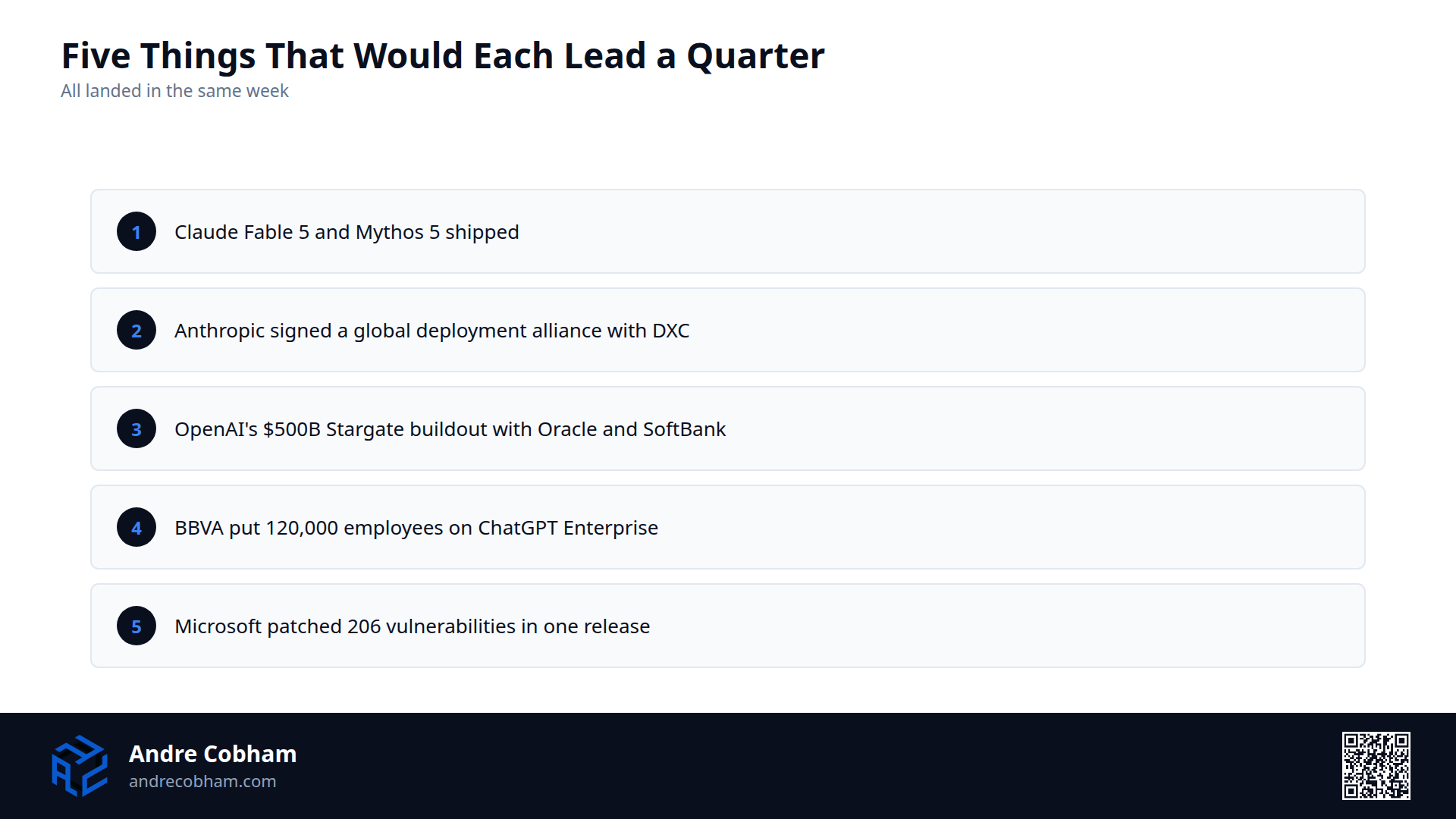
Five things happened this week that individually would each headline a quarter. Claude Fable 5 and Mythos 5 shipped. Anthropic signed a global deployment alliance with DXC. OpenAI announced five new Stargate data center sites and a $500 billion infrastructure buildout with Oracle and SoftBank. BBVA put 120,000 employees on ChatGPT Enterprise. And on Tuesday, Microsoft patched 206 security vulnerabilities in a single release, the largest Patch Tuesday on record.
In my opinion, the common thread is not the models. It is the infrastructure. This week, every major frontier lab moved simultaneously from shipping capabilities to embedding them in production systems at nation scale. That convergence, happening in a single week, is the story.
I have been building on Anthropic's stack in production since late 2024. Not because of benchmarks. Because I used it for real client work and stopped feeling the need to switch. Mythos 5 is the release I have been watching since the Project Glasswing controlled deployment. The safety classifier architecture is what makes it deployable in regulated contexts. That is not a product update. It is Anthropic deciding they are serious about industrial deployment.
TL;DR
Week of June 8-12, 2026: Claude Fable 5 launched June 9 and was suspended June 12 by US government directive. Anthropic Claude Fable 5 + Mythos 5 (June 9), DXC global alliance (June 11). OpenAI Stargate five new sites + $500B buildout, Ona acquisition, BBVA 120K employees (June 8-11). Google Virginia infrastructure investment (June 11). Cohere North Mini Code on HuggingFace. Microsoft Patch Tuesday: 206 flaws, 3 zero-days. Langflow CVE-2026-5027 actively exploited. Three arXiv papers document the containment gap in deployed agentic systems.
Anthropic Claude Fable 5 and Mythos 5 as One Model with Two Products
On June 9, Anthropic released Claude Fable 5 as the most capable model it has ever made generally available. State of the art on nearly every benchmark tested: software engineering, knowledge work, vision, scientific research. What matters more than the benchmark numbers is how Anthropic shipped it.
They released two products from the same underlying model. Fable 5 goes to the public API. Mythos 5 goes to regulated industries via controlled access with a safety classifier layer applied on top. Mythos 5 is what gets deployed into the systems banks, airlines, and government agencies actually run. The split is not about capability. It is an architectural governance decision: rather than restricting who can access the model, they restrict what it can do based on deployment context.
If you have been following how Claude Mythos evolved since the Project Glasswing launch, the Mythos 5 release is the production version of what was previously a controlled research deployment. The safety classifier approach replaces the old access-restriction model. That is a materially different choice for governing a frontier model at infrastructure scale.
Update, June 12: Three days after launch, the US government issued an export control directive requiring Anthropic to immediately suspend all access to Fable 5 and Mythos 5 globally. The directive arrived at 5:21pm ET on June 12. The stated reason: the government believes a jailbreak of Fable 5 was identified. Anthropic reviewed the specific technique and found only minor, previously known vulnerabilities. Anthropic complied with the directive but called it "legally unsound," stating the standard applied here would essentially halt all frontier model deployments industry-wide if applied consistently. Opus, Sonnet, and Haiku access was not affected.
I have been watching the safety classifier architecture since the Glasswing deployment precisely because I expected this kind of intervention. The government did not engage with Anthropic's red-teaming record or challenge the technical specifics. It pulled the model with no warning. If your enterprise AI roadmap depends on a specific frontier model being available next week, this is the case study for why that is a single point of failure. The architecture question is not which model. It is whether your stack degrades gracefully when the model disappears overnight.
Anthropic DXC What Enterprise Deployment Actually Looks Like
Two days after the Fable 5 launch, Anthropic announced a multi-year global alliance with DXC Technology. DXC's business is being embedded directly inside customer organizations to run the systems those organizations depend on: core banking infrastructure, airline reservation systems, healthcare records, logistics networks. The alliance means DXC will train tens of thousands of Claude-certified forward-deployed engineers, each embedded inside a regulated enterprise.
This is not a software license. The model goes into production systems that cannot fail, carried by engineers who own responsibility for those systems. That is the closest thing to a permanent structural position in regulated enterprise that any frontier model has achieved. I have been writing about how agents change team structure at the business level. This is what that dynamic looks like when it reaches Fortune 500 scale.
OpenAI Stargate, Banking, and the Codex Expansion
OpenAI had one of its busiest weeks on record. Three separate enterprise moves landed between Monday and Thursday.
First: OpenAI, Oracle, and SoftBank announced five new Stargate AI data center sites as part of a $500 billion, 10-gigawatt infrastructure buildout across the United States. The scale here is worth sitting with. Ten gigawatts of AI-dedicated compute capacity is comparable to the entire power output of some mid-sized countries. This is not a product roadmap. It is physical infrastructure being built now.
Second: BBVA announced a multi-year AI transformation program with OpenAI, rolling out ChatGPT Enterprise to all 120,000 employees while the two companies co-develop AI solutions for customer interactions and banking operations. This follows the pattern from the Anthropic/DXC deal: not a pilot, not a limited deployment, but a whole-organization commitment.
Third: OpenAI announced the acquisition of Ona, a company that builds secure, persistent cloud environments. The stated purpose is to expand Codex with long-running agent infrastructure, enabling persistent AI agents across enterprise workflows. This matters because current Codex usage is largely stateless. Persistent environments change what agents can actually do across sessions. The acquisition is small but architecturally significant.
Google Infrastructure at Nation Scale
Google DeepMind announced new community investments in Virginia on June 11, framed around job creation and energy infrastructure. The announcement is understated in tone but significant in what it signals: Google is continuing to build AI-specific infrastructure in major data center markets, and it is doing so at a pace that intersects with local energy grid capacity planning. Virginia is the largest data center market in the world. Google building there is not news. The specific framing around energy affordability and workforce development is.
In my experience, combined with the Stargate buildout and the DXC/Anthropic alliance, this week showed all three major frontier labs simultaneously moving from model capability to physical infrastructure. The research race and the infrastructure race are no longer sequential. They are concurrent.
HuggingFace GitHub Open Source and What Shipped This Week
Two releases from the open-source ecosystem are worth noting.
Cohere released North Mini Code 1.0, its first model targeting developers directly, published on HuggingFace as ShaunGves/North-Mini-Code-1.0. Cohere has historically targeted enterprise API customers. A dedicated developer model published to HuggingFace is a positioning shift. It is also a signal that the competition for developer adoption on HuggingFace is intensifying across every major lab.
On GitHub Trending this week, two repositories surfaced that reflect where practitioners are spending time. Apple open-sourced apple/container, a tool for creating and running Linux containers using lightweight virtual machines on Apple silicon, written in Swift. If you are running local AI development on a Mac, this is relevant infrastructure. The second: chopratejas/headroom, a library and MCP server that compresses tool outputs, logs, files, and RAG chunks before they reach the LLM, claiming 60-95% token reduction with equivalent answer quality. Token efficiency at the context boundary is an active engineering problem. This addresses it at the library level.
arXiv The Research Gap with Deployed Agents Ahead of Their Security Frameworks
Three papers published this week document a pattern that runs underneath the deployment announcements: the safety and security frameworks for agentic AI systems were not designed for the environments those systems are now being deployed into.
"The Containment Gap: How Deployed Agentic AI Frameworks Fail Public-Facing Safety Requirements" (arXiv:2606.12797) examines LLM systems deployed in government services, healthcare triage, and financial advising. The finding: systems designed to autonomously invoke tools, maintain persistent memory, and execute multi-step plans are operating in public-facing production environments without safety requirements that match the actual risk profile of those actions.
"Deployment-Time Memorization in Foundation-Model Agents" (arXiv:2606.10062) addresses the memory layer: as foundation model agents become long-lived systems that retain user data across sessions, memorization becomes a deployment-time security property rather than solely a model training property. Existing privacy frameworks were designed for stateless inference. Long-lived agents break those assumptions structurally.
"Beyond Attack Success Rate: Examining Trigger Leakage in Vision-Language Agentic Systems" (arXiv:2606.12586) focuses on vision-language agents that chain visual perception to tool use and physical actions. Backdoor-type triggers in these systems can propagate through both the decision pipeline and connected interfaces, making the effective attack surface larger than the model alone. This is the class of system being built on top of Fable 5.
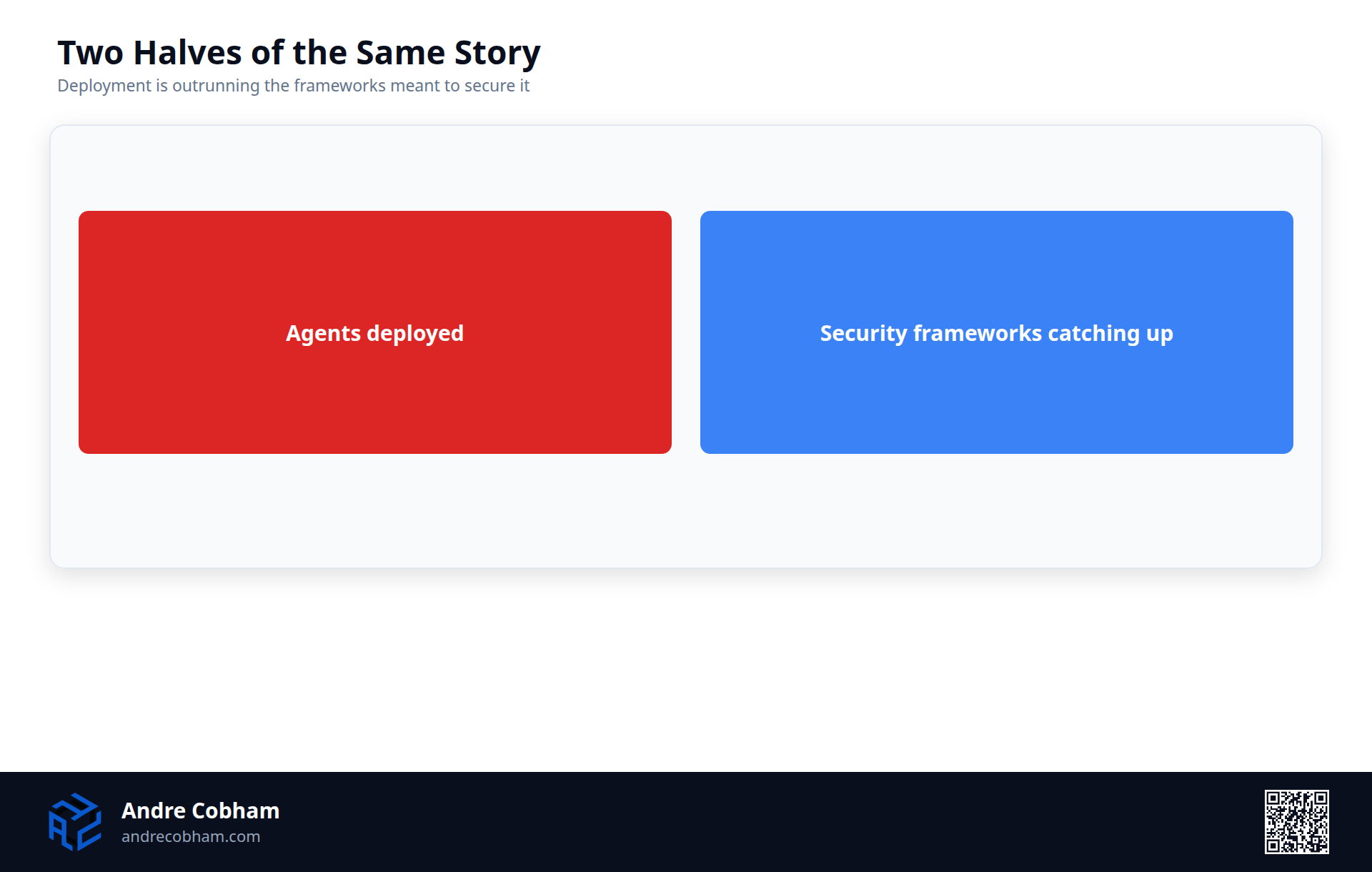
Read together, these three papers describe a production environment that is deploying faster than its containment assumptions can follow. That is the same week DXC announced it is embedding Claude into banking infrastructure.
Microsoft CISA Security This Week
Microsoft released 206 patches on June 10, the largest single Patch Tuesday in the company's history: 39 Critical, 3 zero-days disclosed before patches were available. Patch management at this volume is a risk management function that cannot be handled manually.
Langflow CVE-2026-5027 is under active exploitation. Langflow is a widely-used open-source platform for building AI agent applications. The vulnerability is a path traversal enabling unauthenticated remote code execution, CVSS 8.8. VulnCheck confirmed active exploitation this week. If you are running Langflow in any network-exposed environment, this is not hypothetical. The irony is not subtle: the platform most people use to build AI agents has an unauthenticated RCE vulnerability being actively exploited the same week those agents are being deployed into banking infrastructure.
CISA added Cisco, Chrome, and Arista flaws to the Known Exploited Vulnerabilities catalog and issued a three-day remediation directive for Ivanti Sentry, now confirmed under active exploitation at maximum severity.
What This Week Adds Up To
The frontier model releases are the visible signal. The infrastructure announcements are the structural shift. $500 billion in Stargate data centers, tens of thousands of certified engineers embedded in regulated industries, 120,000 bank employees on ChatGPT Enterprise, and a Mythos 5 safety classifier that separates public access from industrial deployment. All of this in five days.
The three arXiv papers this week are the counterweight. They document, in peer-reviewed detail, that the containment frameworks for this infrastructure did not exist when the deployment decisions were made. That gap between capability deployment and safety framework maturity is the thing worth watching.
I am watching it closely because I see it in every deployment I touch. If you are integrating AI into regulated operations right now, the Containment Gap paper is the most important technical read before you make any architectural decisions. The gap it describes is not theoretical. It is the default state of every enterprise AI deployment I have reviewed.
arXiv Research Spotlight This Week
Four papers from this week worth reading, not the ones that made headlines, but the ones that change how you should think about building.
The Illusion of Multi-Agent Advantage
What I have found is that challenges the assumption that multi-agent systems outperform single agents. Finds the empirical support relies on poorly controlled comparisons. If you are designing agentic pipelines, read this before adding more agents to fix a problem.
Read paper →Evoflux: Inference-Time Tool Workflow Evolution
Compact models (small, cheap, fast) can evolve their own tool call sequences at inference time, discovering tools from live catalogs and satisfying dependencies without retraining. MCP-compatible. Worth watching for edge deployment.
Read paper →The Hidden Power of Scaling Factor in LoRA
The alpha scaling factor in LoRA has been treated as a minor hyperparameter. This paper shows it controls effective learning rate and rank independently, meaning most fine-tuning runs have been suboptimally configured. Practical and immediately applicable.
Read paper →AgentTrust: Per-Action Trust Layer for AI Agents
A self-improving trust layer that decides per-action whether an AI agent should be allowed to execute shell commands, cloud operations, and arbitrary tool calls. Directly relevant to the DXC/Anthropic enterprise deployment announced this week.
Read paper →HuggingFace Model Watch
New and notable model releases on HuggingFace this week, curated for the open-source practitioner.
Kimi-K2.7-Code-MLX-3.6bit
Moonshot AI - MLX quantization by spicyneuron
Kimi K2 is Moonshot AI's frontier code model. This release is a 3.6-bit MLX quantization that runs natively on Apple silicon M-series chips, roughly 3GB RAM for a capable frontier code model on a Mac. If you develop locally on Apple hardware, this is the most practical new release this week.
View on HuggingFace →North-Mini-Code-1.0
Cohere - via ShaunGves
Cohere's first model published directly to HuggingFace targeting developers. North Mini Code is a compact model optimized for code tasks, published alongside the Cohere API. Signals a direct push into the open developer ecosystem rather than API-only enterprise positioning.
View on HuggingFace →finllm-qlora-qwen-7b-finance
emirhuseyin
QLoRA fine-tune of Qwen 7B on financial transaction data. Representative of the growing class of domain-specific adapters that bring frontier base models into regulated verticals without full fine-tuning cost. Relevant if you are building on financial data pipelines.
View on HuggingFace →Stay Current
Get notified when I publish.
No newsletter cadence. No filler. I write when there is something worth saying about AI systems, infrastructure, and what is actually working in practice.
If you are building AI into a business process right now, the question is not which model to use. It is whether the architecture of what you are building matches the threat model of the environment you are deploying into. Most implementations I see do not have a clear answer to that yet. The Containment Gap paper is a useful starting frame. Book a call if you want to work through it for your specific stack.