A client asked me last month why I call what I do infrastructure instead of marketing. The question was honest, and it took me back to the garage in Niagara Falls where the whole thing started. I was on the floor with a screwdriver, my brother, and two Windows 95 machines that did not yet work. My father set the parts down and told us to figure out how they went together. That is where the pattern began. The path from that garage to film studios to search accounts to agentic systems is not a pivot. It is one straight line, and the constant was never a job title. It was one question, asked over and over. How does this system work, and how do I make it better?
The short version is a career that looks like four different jobs and was really one. Hardware taught me how systems fit together. Film and broadcast taught me how they fail and how to make them reliable. A decade in data taught me how to measure them and take out the friction. All of it points at the work I do now, building agentic infrastructure for businesses that are done running on manual effort. The constant was curiosity about the machine behind the result.
How the Pieces Fit Together
Every role I have held was the same job in a different costume: understand the system behind the result and rebuild it to run better. Hardware taught me that a system is components with jobs and connections between them. Live production taught me that the work behind the curtain matters as much as anything the audience sees. Search marketing taught me to find the lever that actually moves the number. The roles looked different, but the underlying work never changed.
What Arising Media Actually Builds
All of it leads here. At Arising Media I build fully agentic experiences for business growth. Infrastructure that thinks. I work with companies that are tired of static websites and manual processes, and I build systems that automate the decisions, surface the insights, and grow with the business instead of holding it back.
In practice that means something specific. When I take on a business I do not start with a website. I start by mapping where decisions still get made by hand, where information sits trapped in one person's inbox, and where the same task quietly gets done twice. Then I build the systems that close those gaps. An agent that drafts and routes the follow-up before anyone has to remember it. A pipeline that pulls data from every platform into one place. A workflow that surfaces the next action instead of waiting to be asked. The website becomes the front door to that machine, not the machine itself.
That is the difference between a digital presence and operational infrastructure, and it is the entire reason I stopped calling this a marketing company. A marketing company sells you attention. I build the machine that runs underneath the business once the attention arrives, so the growth does not depend on someone remembering to do the next thing.
Why the Arc Matters to the Work
The value of the path is not the biography. It is the way of seeing. Film taught me how to hold complexity inside one frame. Broadcast taught me how systems fail under pressure and how to design them so they do not. Data taught me how to measure honestly and take the friction out. I do not bring one of those to a client. I bring all three at once, and they point at the same outcome: a business that runs on infrastructure instead of effort.
The Career That Produced It
Before the Algorithms
My father brought home two Windows 95 machines and asked my brother and me to learn how they worked and put them together. We did not have instructions. We had the parts, the slots they fit into, and the logic that connected them. Taking a machine apart to understand it is the first real thing I ever learned, and it set the pattern for everything after. A system is not magic. It is components with jobs, and connections between them, and if you are patient enough you can trace every effect back to a cause. That garage stuck with me.
By high school at Niagara Falls High School, I had found the place where that instinct had room to run. I spent my time in the OSC21 media and news studio, managing the machines, troubleshooting Final Cut when an edit would not render, repairing the technical board when a channel went dead, and learning stage lighting design one cue at a time. The studio was where hardware, software, and live production met in real time, with an audience on the other end and no second take. Lighting design in particular was my first real systems discipline. Every cue was a state the room had to enter on schedule, in order, with no visible seam, and a single missed input showed up instantly on camera. It taught me a lesson I have never unlearned. Good systems fail quietly, and bad ones fail loudly. The work behind the curtain mattered as much as anything the audience ever saw.
Nobody in that studio was thinking about algorithms. I was, without the word for it. I was already looking past the show to the machine that made the show possible.
The Raphy Report and the Incubator
At SUNY Fredonia I studied film. The coursework was production and storytelling, and I loved it, but my real education came from noticing a gap and deciding to fill it. In 2012, Michael Carbone and I created "The Raphy Report," a student-run, multi-segment news and variety show produced under TRR Productions. It started as a small idea with a camera and a few willing people. It grew into the first organization in the SUNY Fredonia Technology Incubator operated solely by students, which meant we were not playing at running a company. We had a real seat, real overhead, and real expectations to answer for.
Growth was the education. The show pulled in more than 50 interns across graphic design, business, public relations, journalism, accounting, theater, art, and computer science. Coordinating that many people from that many disciplines, with almost no budget, is an operations problem long before it is a creative one. Who owns which deliverable. What happens when the accounting intern and the art intern need the same afternoon. How you keep a production on air when everyone involved is also carrying a full course load. We also co-founded V3 Studios, the Incubator's first student-founded tenant, a video production company that ran with three employees and eleven clients. Managing eleven clients with three people forces you to systematize everything that would otherwise live in someone's memory, because memory does not scale and people burn out.
That was the first time I built infrastructure that had to hold weight it did not choose. The lessons were about resource constraints and cross-functional coordination, and they were unforgiving. You scale by designing the process, not by working harder inside a broken one. I learned to build things that did not break under load, because ours had no margin to spare.
Where Film and Infrastructure Met
The Dunkirk Access 12 station is where film and technology finally clicked into one thing for me. The station needed a complete rebuild, and I took it on. I ran fiber, set up device automation, and moved the broadcast off a single laptop and onto a system built to actually carry it. Before that, the entire operation balanced on one machine, which is to say it balanced on nothing. One failure and the signal was gone. The automation mattered as much as the hardware, because every manual switch and hand-started feed was one more place a tired person forgets a step under pressure and takes the whole broadcast down with them.
That project rearranged how I think about infrastructure. It is not a cost center you tolerate. It is the backbone that decides whether everything sitting on top of it stands up or falls over. Every day the broadcast went to air, every camera that worked, every feed that connected, was a day the infrastructure quietly did its job and nobody had to think about it. Invisible reliability is the highest compliment a system can earn.
That is also the moment I stopped believing I was in film for film's sake. I cared about the machine that made the stories possible more than I cared about any single story. The realization did not feel like a detour. It felt like finding the actual subject.
A Decade in Data
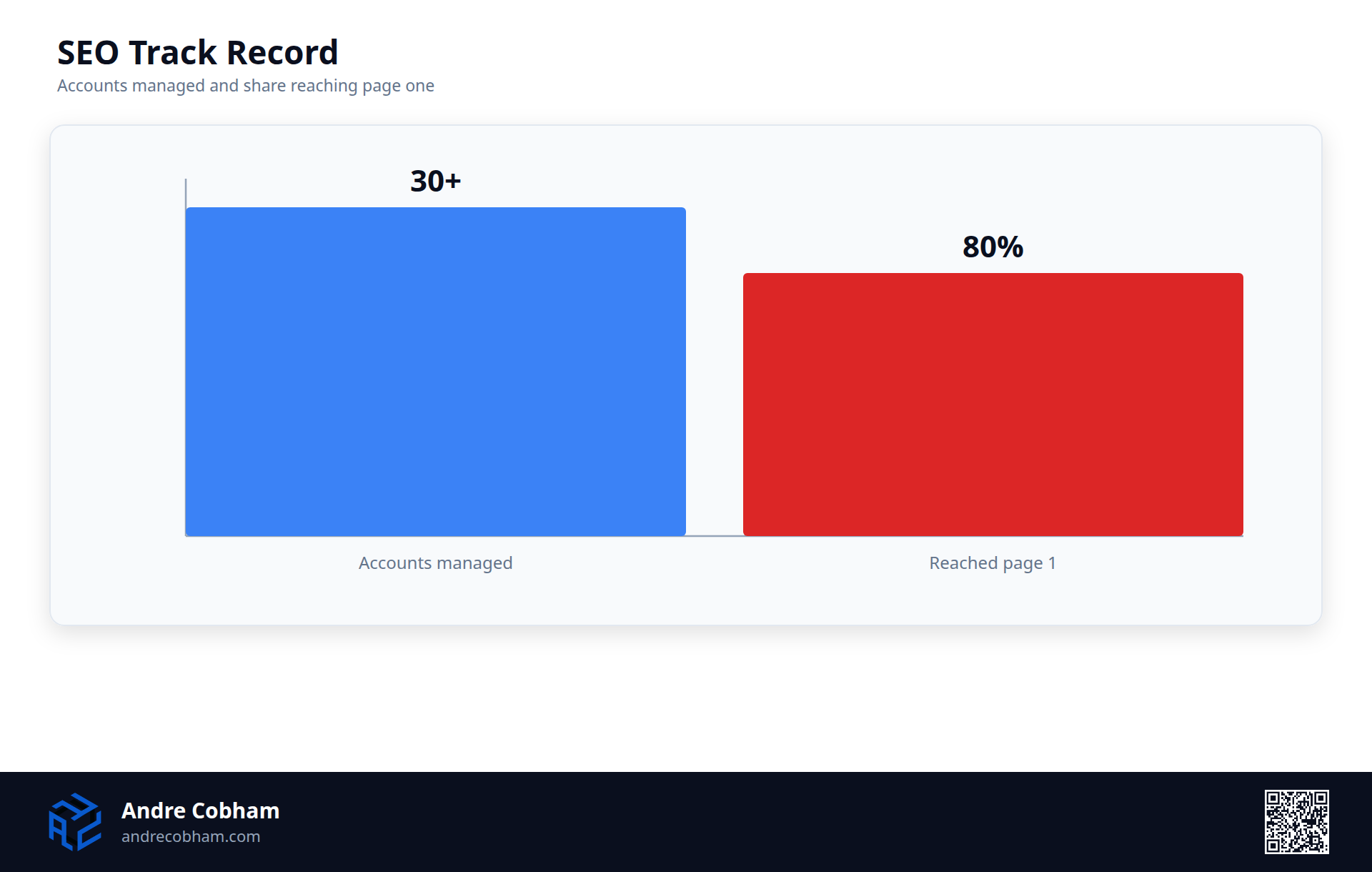
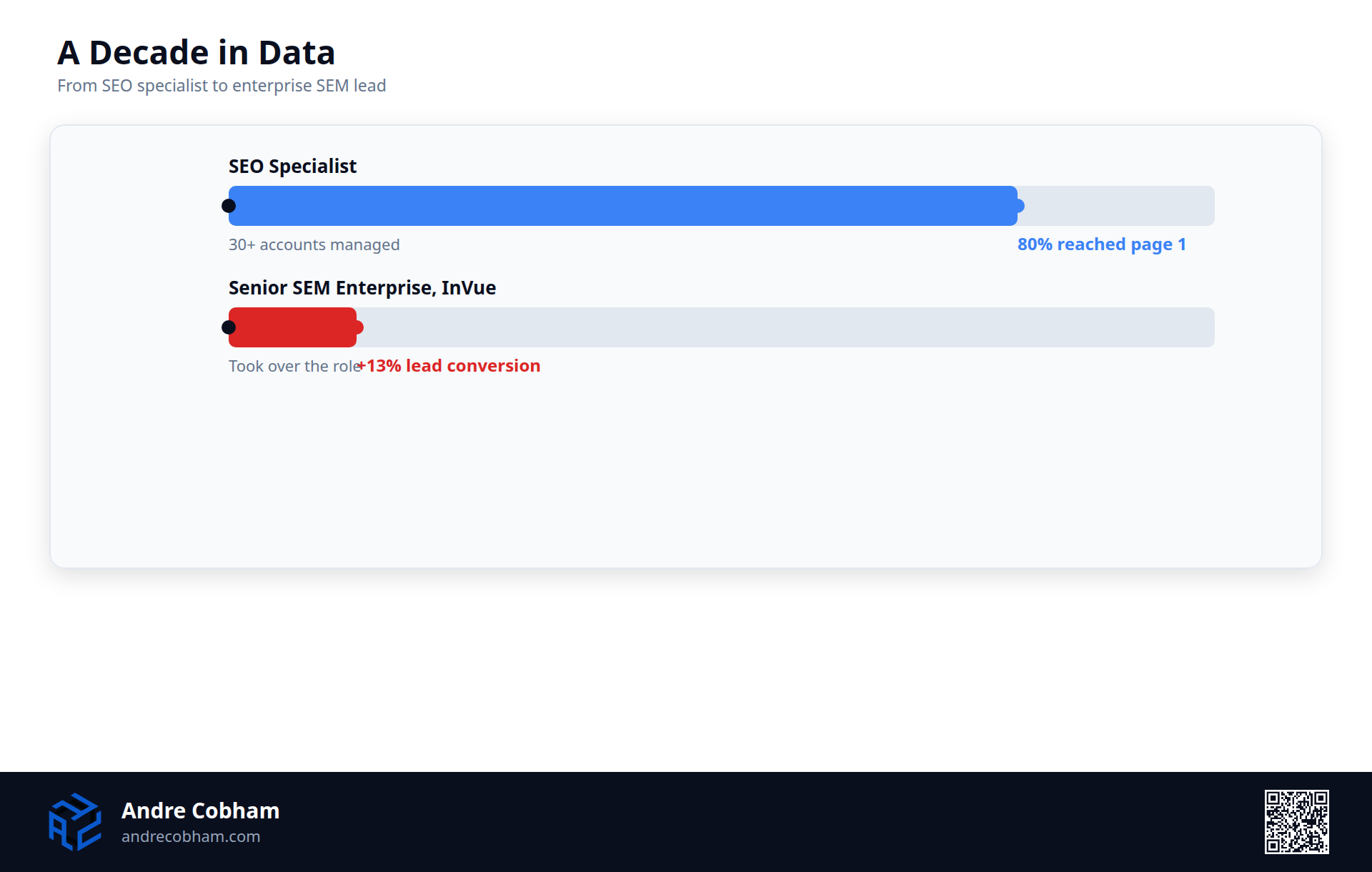
From 2013 onward I moved into marketing and search. As an SEO Specialist I managed more than 30 accounts and drove over 80 percent of them to the first page of search results. That was the foundation, and it was pattern recognition at scale. Every account was a system with inputs and outputs, and the job was to find which lever actually moved the ranking and which ones only looked like they did. Thirty accounts also meant I could not treat any one of them as a special case. I had to build repeatable process, or I would drown.
From 2014 to 2017 I worked as an SEM Strategist and Senior Search Marketing Specialist, and the questions sharpened. Which keywords, which messaging, which channels, which timing. How does the funnel flow, and where exactly do prospects fall out of it. I stopped treating campaigns as creative gestures and started treating them as systems you can instrument, measure, and tune at every stage.
From 2018 to 2021 I was an Enterprise Account Manager at InVue Digital, running SEM and PPC campaigns across Buffalo and the Niagara Falls region. Late in 2021 I moved into a Senior SEM Enterprise role and delivered a 13 percent improvement in lead conversion rate. The number mattered, but the thing I am proudest of from that period is quieter. I deployed a reporting pipeline on Google Cloud Storage buckets and Google Data Studio that automated client reporting from end to end. It captured data from multiple platforms and routed all of it into a single dashboard, so every client saw performance in real time instead of waiting for someone to assemble a slide deck. Hours of manual work every month disappeared, and the reporting got more accurate at the same time.
That pipeline is where the rest of my career started to make sense. The point was never impressive technology. The point was an invisible system that removed friction and put the right information in front of the right person at the right time.
Basil Marketing and Transcat
At Basil Marketing Group I built systems for restaurants and automotive brands. I linked digital signage to inventory and live campaigns, set up UTM tracking so every dollar traced back to an outcome, and managed co-op budgets that were otherwise a monthly source of confusion. Then I automated the reporting that sat on top of all of it. The goal never changed. Build the infrastructure so the marketing team spends its hours on strategy instead of stitching spreadsheets together. Every system I put in place was designed to make the next person's job easier, including the version of me who would have to maintain it a year later.
That ethos carried straight into Transcat, where I was Digital Marketing Manager from 2021 to 2023. There the work moved up a level. I standardized KPI reporting across the organization, secured investment in marketing technology, and analyzed digital channels through multiple acquisitions. When the company acquired another business, I was the person who mapped the new marketing landscape, found the redundancy, and proposed how the two should come together. Standardizing KPIs across a whole organization is less a reporting task than a translation task, getting teams that measured success differently to agree on what a good number even means. That is not campaign work. That is systems thinking applied directly to how a business grows.
By then the pattern was undeniable. I had spent a decade being handed messy operations and quietly turning them into infrastructure. It was time to do that on purpose.
My Take
Every business I work with now is standing where those earlier systems stood before I rebuilt them. Decisions made by hand that a machine should be making. Information locked in one person's head. The same task done twice because nobody wired the two halves together. I recognize it on sight, because I have spent my whole career on the other side of that problem, first in a broadcast studio, then across thirty search accounts, then inside organizations moving through acquisitions.
What the arc gave me is a way of seeing. Film taught me how to tell a story and hold complexity inside one frame. Broadcast and hardware taught me how systems fail and how to design them so they do not. Data taught me how to measure a thing honestly and take the friction out of it. I do not bring one of those to a client. I bring all three at once, and they point at the same outcome, a business that runs on infrastructure instead of effort.
I am direct about this with the people I work with. You do not need more tools. You need the system that makes the tools work together while you sleep.
The constant across every role was never the title on the door. It was curiosity, problem solving, and a stubborn interest in the machine behind the result. My career is one line from assembling a computer on a garage floor in Niagara Falls to architecting agentic infrastructure for the businesses I serve. The garage never left me. It is still exactly how I work.