
I see the same pattern across the service businesses I work with: a full calendar this month, an empty one three months out. That gap is not bad luck. It is the difference between a business that only captures demand already searching for it, and one that also builds new demand before the phone rings.
I work with service businesses doing $300,000 to $500,000 a year. The ones I have run this with for five years straight closed that exact gap and grew past $1 million, some well past it, at 45 percent year over year. This is the pattern, not one client's story.
The service businesses that plateau run one play, capturing demand that is already searching. The ones that grow 45 percent a year add a second play, building demand before the phone rings. Two levers do most of the near-term work, a Google Business Profile run as a live signal and campaign structure that stops urgent and routine searches from sharing a budget. Neither costs more. Both compound, which is how a $400,000 business becomes a $1 million one inside five years.
Why Growth Stalls After Year Two
Growth flattens in year two because you hit the ceiling of one channel, not because you lost your edge. Most service businesses run a single play. They turn on Google Ads for people already searching, collect the calls, close the jobs. That play works fast because a steady pool of people needs the service right now. The trouble is the pool has a fixed size and you share it with every other operator in your market.
Picture a stocked pond. The catching is good early because the fish are there and few rods are in the water. Then more rods arrive, the stock stays the same, and every operator casts harder for the same fish. That is a bidding war, and the numbers show it. LocaliQ's 2025 home services benchmarks put the average cost per lead at $90.92 and report that cost per lead rose for 69 percent of home services advertisers, up 10.51 percent year over year, as more competitors entered the same auction. Conversion rates fell across most categories in the same window. You pay more and close a smaller share.
So a business living on capture alone hits a wall it cannot buy through. Every extra dollar chases a call that costs more than the last. Casting harder will not raise the ceiling.
Demand Capture and Demand Generation Are Not the Same Game
Capture and generation do two different jobs, and confusing them is why most owners think they have a marketing problem when they have a portfolio problem. Demand capture meets a buyer at the moment of need. Someone types "water heater replacement near me" and you show up with a bid. Demand generation plants your name in that buyer's head weeks or months before the water heater fails, so when it does, you are the first business they think of and often the only one they call.
The reason generation matters is timing. Google's research found that 76 percent of people who search for something nearby on a smartphone visit a related business within a day. That search happens whether or not you spent anything to earn it. If your name is already familiar when the moment arrives, you win the visit at a fraction of the cost. If it is not, you buy the click and fight for it in the auction.
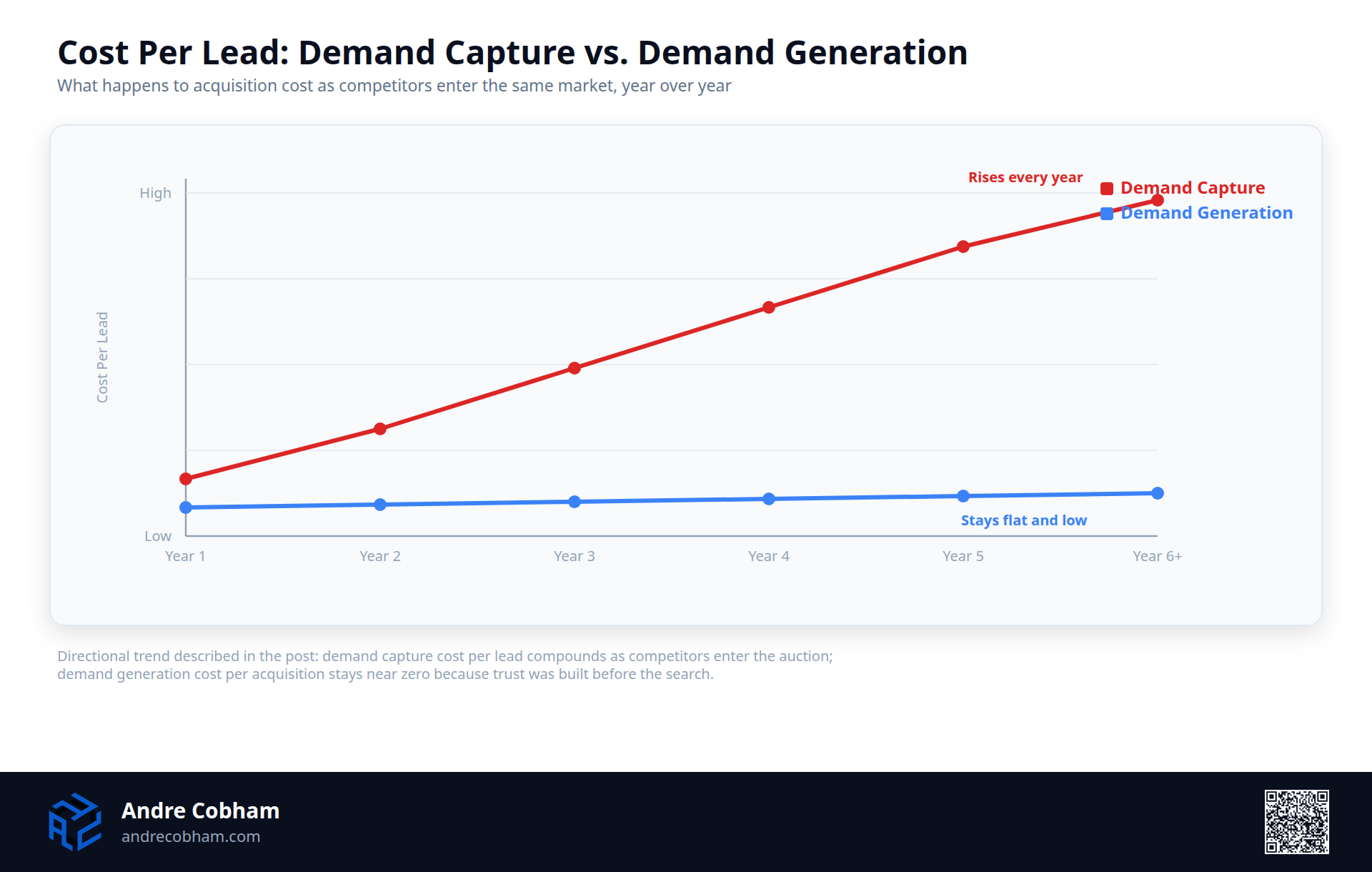
The split that matters is this. Capture cost climbs every year because the auction only gets more crowded. Generation cost stays flat because you built the trust once and it keeps paying. Run only the first and your cost to grow rises forever. Run both and the expensive channel funds today while the cheap one funds tomorrow.
The Two Plays That Do Most of the Near-Term Work
The first play is the Google Business Profile, run as a live signal instead of a form filled out once and forgotten. The businesses stuck below the local three pack set theirs up on day one and never touched it again. The businesses inside the three pack feed it every week. That difference decides who shows up when a homeowner searches, and showing up is most of the battle.
What feeds the signal is specific. Whitespark's ranking factor research puts review recency and volume, and the frequency of new photos, among the strongest prominence signals that separate the top of the local pack from everyone below it. A profile collecting fresh five star reviews every week and new job photos on a schedule tells Google the business is active and trusted. A stale one tells it nothing. I put a simple cadence on every account, a review request the day a job closes and field photos uploaded each week, and rank moves within a quarter.
The second play is campaign structure, and the single change that pays the most is separating urgent searches from routine ones so they stop sharing a budget. An emergency search like "same day AC repair" and a planning search like "HVAC maintenance contract" want different things and book jobs at different values. When they sit in one campaign with one budget, the algorithm cannot tell which one you meant to prioritize. It optimizes for whatever converts cheapest.
Cheapest usually means the lower intent search, which quietly starves the traffic that books same day. The homeowner with water in the basement is worth far more than the one comparing maintenance plans for next spring, but the algorithm does not weigh revenue, it weighs cost per conversion. I split them into separate campaigns with separate budgets, one tuned tight around the service address for same day work, one broader across the service area for planning searches.
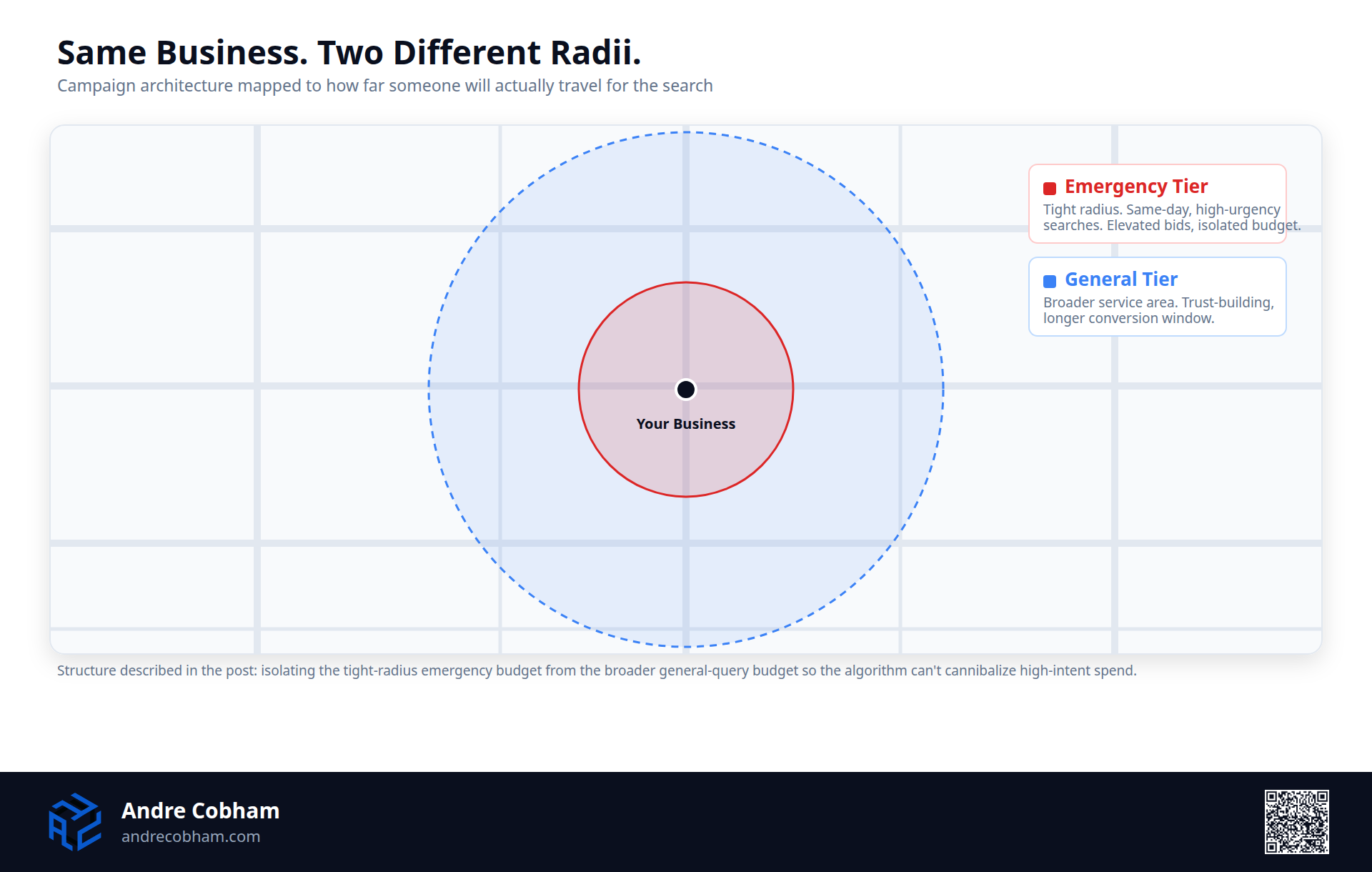
The result is control. The emergency budget stays fully funded for the calls that book today, and the routine budget builds the pipeline for next month without cannibalizing it. Same total spend, more booked revenue, because the money finally lands where the value is.
What Building Demand Actually Looks Like for a Service Business
Build demand sounds abstract until you turn it into five concrete habits a service business can run without a marketing department. This is not brand advertising or a rebrand. It is showing up in the same market, on the same channels, consistently enough that your name becomes the familiar one. Here is what I put in place.
Google Business Profile posts go out weekly, a finished job, a seasonal reminder, a short offer, so the profile stays active and the business stays visible in the map results between searches. Short vertical video comes next, thirty to sixty seconds of a real job filmed on a phone, a technician explaining a common failure, a before and after. It is cheap and fast, and it puts a face on the name so the business stops being a faceless bid in a list. Neither takes a studio. Both take a schedule.
Then the referral loop, which carries the most weight of all. Nielsen's 2021 trust study found that 88 percent of people trust recommendations from someone they know more than any other channel, which means a referred prospect arrives already sold in a way no ad can match. I make the ask systematic, a simple message after every completed job that invites the customer to pass a name along, tracked so it happens instead of relying on memory. A referred lead costs nothing to acquire and closes higher than a cold click ever will.
The last two are an owned email list and plain consistency. Every past customer and every quote that did not close goes on a list I message with something useful each month, a maintenance tip or a seasonal heads up, so the business stays top of mind for the next need. Underneath it all sits the discipline of showing up every week, month after month, when it feels like nothing is happening. That is the part most owners quit before it pays. The ones who do not own a channel the auction cannot take from them.
The 90 Day Rollout I Run
I never turn all of this on at once, because a business that tries to fix everything in one month fixes nothing and burns out. I run it in three thirty day blocks, fastest payback first, so early wins fund the patience the slower plays need. Sequence beats intensity here.
The first thirty days are pure capture cleanup, the changes that pay this month. I split the emergency and routine campaigns, fix the tracking so every call ties back to its source, and start the review and photo cadence on the Google Business Profile. These moves cost nothing extra and lift booked revenue inside the first billing cycle, which buys credibility for everything that follows.
The second thirty days start the generation engine. Weekly profile posts begin, the first short videos go out, and the referral ask goes into the job close so it happens automatically. The third thirty days build the compounding layer. I stand up the email list and start its monthly rhythm, the video cadence steadies, and I begin watching the one number that tells me the engine is catching. By day ninety the capture side is tighter and cheaper, and the generation side is planted. One is paying now. The other will pay for years.
What Compounds Underneath the 45 Percent
The 45 percent is not the story. What compounds underneath it is. A company doing $300,000 to $500,000 a year that grows 45 percent annually crosses $1 million inside five years, and some go well past it. That is the math of compounding, not a projection for any single business, because every account starts from its own baseline. The number people fixate on is the growth rate. The number that produces it is quieter.
What actually compounds is profile signal strength, the review base, and the share of calls arriving direct or through branded search instead of paid clicks. Each year more of your demand comes from people who already knew your name, and that demand costs nothing per click while the shared auction only gets more expensive. So the growth is not that you learned to buy leads better. It is that a growing slice of your leads stopped being leads you had to buy at all.
That is the quiet part of the 45 percent, and competitors cannot copy it by outbidding you. They can match your budget tomorrow. They cannot match a review base and a name you spent three years building. Rented demand gets more expensive. Owned demand gets cheaper. Own more of it each year and the growth rate takes care of itself.
The One Number That Tells You It Is Working
If I watch one number to know whether the second play is catching, it is the ratio of branded and direct calls to paid ones. Early on, almost every call traces back to an ad you paid for, because nobody knows your name yet and the only way in is the auction. That ratio is the honest scoreboard for demand generation, and it moves long before revenue does.
By year three in the accounts running both plays, a third to a half of the calls arrive through branded search, a direct visit, or a referral from someone who already trusted the name before they dialed. Those calls cost nothing per click. When that share climbs quarter over quarter, the generation engine is working even if this month's paid lead count looks flat. When it stays pinned near zero, the business is still renting every call it gets, and the plateau is coming back.
This is the number I point owners to first, because it separates building an asset from renting attention. A rising branded share means you own a channel that gets cheaper as it grows. Watch that ratio and you will see the turn a full year before revenue confirms it.
My Take
Here is what I tell owners who ask why their growth flattened. You did not lose your touch. You maxed out a single channel. Demand capture has a hard ceiling, the size of the pool searching right now, and once you and every competitor are bidding on it, the only move left is to pay more for the same finite calls. That is not a growth strategy. It is a treadmill with a rising incline.
The businesses that broke past a million did not find a secret channel. They added the second play, building demand before the search, and let it compound quietly underneath the first. It starts slow and it does not show up in this month's lead count. It shows up in year three, when a growing share of your calls arrive already knowing your name and your cost to win them stops climbing. If your calendar is full now and thin in ninety days, that gap is not a warning. It is the whole opportunity, buyable with patience most competitors will not spend.
If your growth has plateaued and you want a straight second opinion on your account, reach out and we can look at what is actually happening under the numbers.