
A client asked this week whether their first agent was ready for production. The demo worked, the team was excited, and the business case was clear. The right question was not whether it worked. It was whether the governance around it was strong enough to let the agent fail safely when something inevitably went wrong. That question is the thread connecting every item this week, from healthcare guardrails to financial analysis benchmarks to the documentation agents that are simpler than the multi-agent hype suggests.
This week's research shows agent deployment moving from capability demos to production governance. The TRiSM framework gives healthcare a structured model for trustworthy agent deployment. Cheaper production models expand the workflow space that agents can economically handle. Scientific model discovery and financial IPO analysis both benefit from iterative agent loops, but only when grounded in real transactions and real documents. Multi-agent documentation systems do not automatically beat single-agent approaches. The common thread: the hard part is no longer building the agent. It is building the guardrails around it.
Why Governance Is the Production Constraint
Most businesses I work with can build or buy an agent that completes a useful task. The gap appears when they try to let it run without a human in every step. An agent with tool access is an actor in your infrastructure, not a smarter chatbot. That means it needs identity, permission scoping, failure-mode analysis, and audit trails, the same rigor you would apply to any service making calls against production systems. The research this week offers several concrete ways to think about that rigor.
What ASYNC Covers
ASYNC is the weekly digest I use to surface the research that actually changes operational decisions. It is not a list of every paper. It is the five items that move the deployment conversation forward, with a short take on what each one means for a business running agents in production or planning to.
The Practical Value of the Governance Lens
The value of reading research through a governance lens is that it separates what is impressive from what is safe to ship. A model can score well on a benchmark and still be the wrong choice for a workflow where a wrong action has patient-safety or financial consequences. The frameworks and benchmarks below are the beginning of a checklist for that decision.
The Five Items This Week
Security: TRiSM-Guided Agentic Workflows in Healthcare
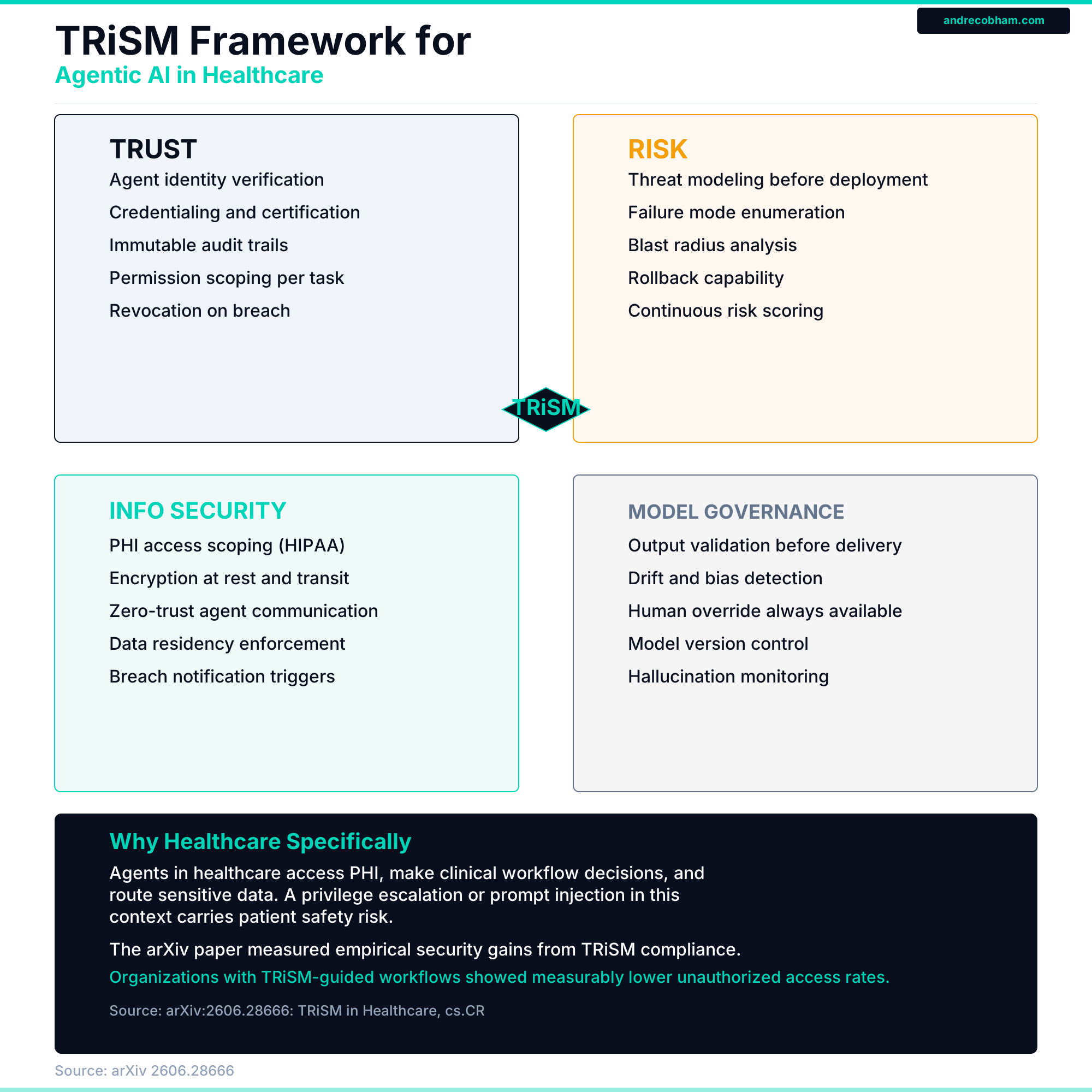
According to arXiv 2606.28666, agent-based AI in healthcare introduces a specific risk profile that general enterprise AI governance frameworks do not adequately address. The paper examines what happens when LLM agents with elevated access rights, often exceeding those of ordinary users, are deployed into clinical workflows. The TRiSM framework, which structures governance across Trust, Risk, Information Security, and Model Governance, provides the empirical basis for the paper's finding that structured governance produces measurable security improvements over ad-hoc deployment.
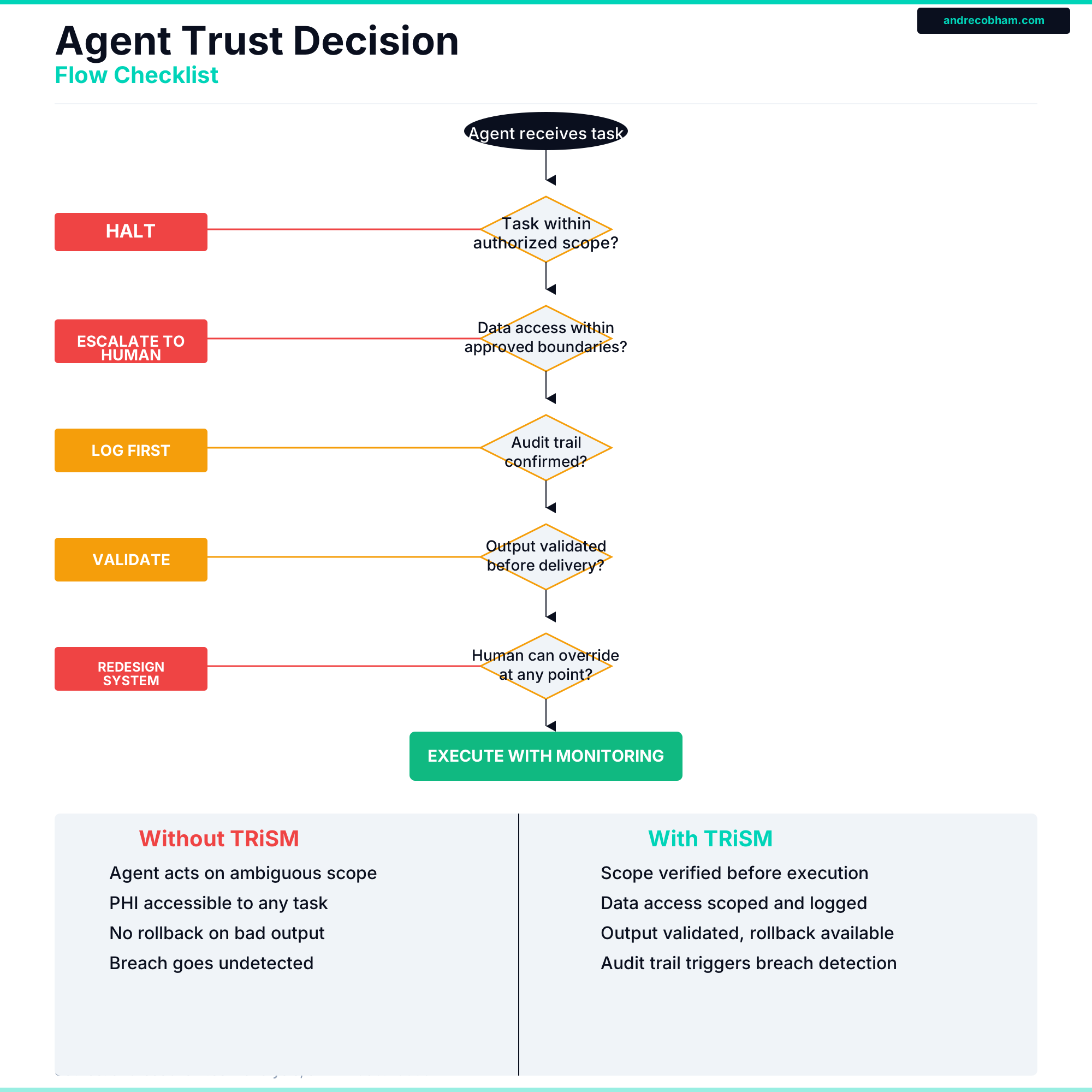
The TRiSM framework applied to healthcare agents organizes governance into four operational pillars. Trust covers agent identity verification, credentialing, permission scoping per task, and revocation mechanisms on breach. Risk covers threat modeling before deployment, failure mode enumeration, blast radius analysis for each agent action, and continuous risk scoring during operation. Information Security covers PHI access scoping under HIPAA, encryption requirements, zero-trust agent communication protocols, and data residency enforcement. Model Governance covers output validation before delivery to clinical users, drift and bias detection, human override availability at all times, and version control for deployed models.
The paper's empirical contribution is the measurement of security outcomes under TRiSM-guided deployment versus ad-hoc deployment. Organizations with TRiSM-guided workflows showed measurably lower rates of unauthorized access attempts, lower rates of successful data exfiltration in red-team exercises, and more consistent audit trail completeness. These are operational outcomes, not theoretical framework benefits. The comparison is not between TRiSM and nothing: it is between TRiSM and the governance approaches that organizations without a structured framework actually implement.
The healthcare context amplifies the stakes of each governance failure mode. A privilege escalation in a healthcare agent workflow is not an IT incident. It is a potential patient safety incident. A prompt injection that redirects an agent away from its intended clinical task has consequences that extend beyond the security domain into clinical outcomes. The TRiSM framework addresses this by treating governance as a precondition for deployment rather than a retrofit after the fact. The paper recommends governance review as a gate in the deployment process, not as an audit after go-live.
Andre Cobham on this: Healthcare AI governance is where the consequences of getting it wrong are most visible and most severe. But the TRiSM framework's four pillars apply to any high-stakes agent deployment, not just healthcare. Trust, Risk, Information Security, and Model Governance are the right categories for any organization deploying agents with elevated access rights. Healthcare makes the stakes explicit. Every other regulated domain has equivalent stakes with less visibility.
AI: Claude Sonnet 5 and the Economics of Production Agent Execution
Claude Sonnet 5 launched this week, positioned by the company as a cheaper path to production agent execution compared to the flagship Opus model. The pricing is lower than Opus while maintaining strong agentic capabilities, improved safety characteristics, and benchmark performance competitive with GPT-5.5 and Gemini Pro on agent-specific tasks. Source: TechCrunch.
The pricing positioning is the operationally significant detail. Agent workflows consume tokens at a fundamentally different rate than single-turn interactions. An agent completing a multi-step task invokes the model at each step, processes retrieved context at each step, and maintains conversation history across steps. The token consumption per completed task can be an order of magnitude higher than a single-turn interaction that achieves the same result. At flagship model pricing, the economics of agent workflows can be difficult to justify for routine business tasks.
A model with strong agentic capabilities at lower pricing changes the economics of which workflows can be profitably automated. Tasks that were marginally viable at flagship pricing become clearly viable. Tasks that were not viable at all at flagship pricing move into evaluation range. The addressable workflow space for agentic AI expands when the per-task cost falls. For organizations that have modeled agentic automation and found it marginal at current pricing, the Sonnet 5 launch is a prompt to rerun those models.
The safety improvements are the other notable aspect of the launch. Improved safety characteristics in an agent context are not about preventing the model from producing harmful content in chat, which is a different problem. They are about the model maintaining appropriate behavior boundaries when operating autonomously in multi-step workflows, resisting prompt injection attempts, and declining actions outside its authorized scope. These are the safety properties that matter for production agentic deployment, and they are qualitatively different from the safety properties relevant to consumer chat applications.
Andre Cobham on this: The economics of agent workflows are sensitive to per-step model cost in a way that single-turn interactions are not. A cheaper model with equivalent agentic capability does not just reduce cost on existing workflows. It makes previously marginal workflows viable and brings a new category of workflows into evaluation range. Sonnet 5 is worth benchmarking against current Opus-dependent workflows to quantify the cost reduction before assuming the capability gap matters.
Science: Probabilistic LLM Model Discovery for Scientific Research
According to arXiv 2602.18266, the application of LLM-based agentic workflows to mechanistic model discovery in science addresses one of the most time-consuming and expertise-intensive parts of the scientific process. The paper proposes a probabilistic framework in which an LLM agent iteratively proposes mechanistic models from observational data, evaluates each proposal against the data, revises based on evaluation results, and continues until it converges on a model with acceptable fit.
The agentic structure is the key design decision. A single-pass LLM query can generate a candidate mechanistic model. But mechanistic model discovery is inherently iterative: the first proposal is rarely adequate, the evaluation reveals what the proposal got wrong, and the revision incorporates that feedback. The agentic workflow, which supports multi-step iteration with intermediate reasoning, is better suited to this task than a single-turn interaction. The paper demonstrates that the iteration count to convergence decreases as the model improves its initial proposal quality from earlier iterations.
The paper's evaluation demonstrates performance on model discovery tasks across several scientific domains, including pharmacokinetics and epidemiological modeling. The framework is not domain-specific: the same iterative proposal-evaluation-revision loop that works for pharmacokinetic modeling works for any domain where the task is discovering a mechanistic model that fits observational data. The paper's documentation of the framework architecture is sufficient to implement it for new scientific domains without requiring deep modification of the core loop.
For research institutions and scientific computing teams, this framework represents a practical acceleration of a bottleneck that has historically required significant domain expertise and iteration time. The LLM agent does not replace domain expertise in evaluating whether a proposed model makes physical or biological sense. It accelerates the proposal and technical evaluation stages, leaving domain-level judgment to human scientists. The result is a compression of the iteration cycle that makes model discovery tractable for research teams that would otherwise spend months on the search phase.
Andre Cobham on this: Mechanistic model discovery is exactly the kind of iterative, expertise-intensive task that agentic workflows are well-suited to accelerate. The agent handles the systematic search through model space. The human scientist handles the domain judgment about whether the discovered model makes scientific sense. That division of labor makes sense because the systematic search is the bottleneck the agent can address, and the domain judgment is what the scientist is best positioned to provide.
Research: The Illusion of Agentic Complexity in Documentation Generation
According to arXiv 2606.30524, multi-agent systems for README and documentation generation do not outperform single-agent approaches in a direct comparison. The paper evaluates single-agent versus multi-agent RAG architectures on repository-level documentation generation and finds that the additional coordination overhead of multi-agent systems does not produce quality improvements sufficient to justify the complexity cost.
The finding challenges a common assumption in agentic AI design: that more agents produce better results. The paper's analysis identifies why this assumption fails for documentation generation specifically. The task requires coherent synthesis across a codebase. Multi-agent approaches, where different agents handle different components, introduce coordination challenges that can produce inconsistent documentation voice, redundant content across sections, and missed cross-component relationships that a single agent with full context would capture. The coordination overhead is not neutral: it introduces failure modes that the single-agent approach avoids by construction.
The paper's contribution is not a finding against multi-agent systems in general. It is a finding that the choice between single-agent and multi-agent architectures should be driven by whether the task structure benefits from parallelism and specialization, not by the assumption that more coordination produces better results. Documentation generation is a synthesis task where coherence requires full context. It benefits from a single agent with complete access to the codebase, not from specialized agents handling components in parallel. The paper provides a useful heuristic: if the task requires coherent synthesis, start with a single agent.
The evaluation methodology is also a contribution: the paper develops automated evaluation criteria for documentation quality that go beyond surface metrics to assess coverage, accuracy, and coherence. These criteria are applicable to evaluating documentation generation systems beyond the specific architectures the paper compares. Teams building documentation generation pipelines can use these criteria to evaluate their own systems against the same dimensions the paper measures, providing a reproducible quality benchmark for a task that has historically been evaluated subjectively.
Andre Cobham on this: The complexity of an agent architecture should be justified by the task structure, not assumed to produce better results by default. Multi-agent approaches add coordination overhead and introduce coherence risks that are not free. For tasks requiring synthesis across a large context, a single well-configured agent with full context access is often the right architecture. Evaluate based on output quality on the actual task, not on the sophistication of the coordination pattern.
Finance: IPO Finance Agent Benchmark on the SpaceX SPCX IPO
According to arXiv 2606.23032, the IPO Finance Agent benchmark extends the Finance Agent v2 framework to evaluate LLM performance on financial analysis tasks beyond periodic reporting from publicly traded companies. The benchmark uses the SpaceX SPCX IPO as the evaluation case because it tests financial analysis capabilities on a complex, high-profile transaction that involves private company valuation, regulatory filing interpretation, and forward-looking financial modeling under uncertainty.
The benchmark methodology introduces automated rubric generation, which produces evaluation criteria derived from the specific financial documents and deal structure of the case being analyzed rather than from a static rubric designed for general financial analysis. This is a meaningful improvement over fixed rubrics because IPO analysis is inherently transaction-specific: the relevant analytical dimensions for a SpaceX IPO are different from those for a different industry or deal structure. A fixed rubric designed for general financial analysis systematically underweights dimensions that matter for the specific transaction type being evaluated.
The evaluation results show significant variation across frontier models on this benchmark. The tasks that differentiate high-performing from lower-performing models involve reasoning about valuation uncertainty, interpreting regulatory filing language in context, and synthesizing information across multiple financial documents to form a coherent analytical position. These are the tasks where domain expertise and reasoning quality matter most and where token generation quality is insufficient. The benchmark identifies these differentiation tasks clearly enough to use as a targeted evaluation suite.
The broader contribution is a public benchmark for a task class, IPO financial analysis, that represents a high-stakes, high-value application of LLM agents. Financial institutions evaluating LLM agents for transaction support workflows now have a public benchmark that tests the capability dimensions that matter for that use case. The benchmark is reproducible, the evaluation criteria are documented, and the SpaceX SPCX IPO provides a rich, publicly documented transaction with enough complexity to stress test model capabilities across the full range of financial analysis tasks.
Andre Cobham on this: Financial analysis benchmarks that use real transactions are more useful than synthetic benchmarks because the complexity is genuine rather than constructed. SpaceX's IPO involves the kind of ambiguity, regulatory nuance, and multi-document synthesis that characterizes real financial analysis work. Models that perform well on this benchmark have demonstrated something about their reasoning capability on the actual task. That is a stronger signal than performance on a designed test case.
Sources: arXiv 2606.28666, techcrunch.com claude-sonnet-5, arXiv 2602.18266, arXiv 2606.30524, arXiv 2606.23032