
By Thursday I had three separate client conversations that all ended in the same place. Each business had already proven that AI could do a useful piece of work. The question they were stuck on was not whether the tools worked. It was whether to keep renting capability at current prices, or to start building the operational layer, the governance, the localization, and the cost model, that makes the capability durable. That is the shift from foundation-model experimentation to deployment infrastructure, and it is the thread running through every item this week.
This week the research feeds point past the model announcements and toward the infrastructure that makes AI deployable at scale: custom silicon, regional enterprise expansion, energy-aware on-device inference, open versus premium tooling economics, and desktop agents built for non-technical users. The common thread is that deployment, not capability, is now the constraint.
What the Shift From Models to Infrastructure Looks Like
Most businesses I talk to are past the demo phase. They have seen a model write a draft, summarize a document, or generate code. The next questions are harder. How much does it cost to run at volume? Does it work under real thermal and battery constraints? Does it comply in the regions where we operate? Can a non-technical employee actually use it? These are infrastructure questions, and they are showing up in the research this week more than new benchmark scores are.
What We Do With These Signals
ASYNC is the weekly digest I run for operators who need to know which research actually changes their decisions. The goal is not to cover every paper. It is to find the five items each week that move the deployment conversation forward, then connect each one back to what a business should do differently on Monday morning. The items below are this week's five.
Why the Infrastructure Layer Matters More Than the Headline
The value of tracking infrastructure instead of announcements is timing. A model launch tells you what is possible. A silicon partnership, a regional office opening, or an energy-aware inference framework tells you what will be economical, compliant, or usable six to eighteen months from now. Businesses that plan around those signals avoid committing to cost models that are about to be undercut, and they avoid building workflows on tools that their non-technical staff cannot adopt.
The Five Items This Week
Tech: OpenAI and Broadcom Announce Custom LLM Inference Silicon
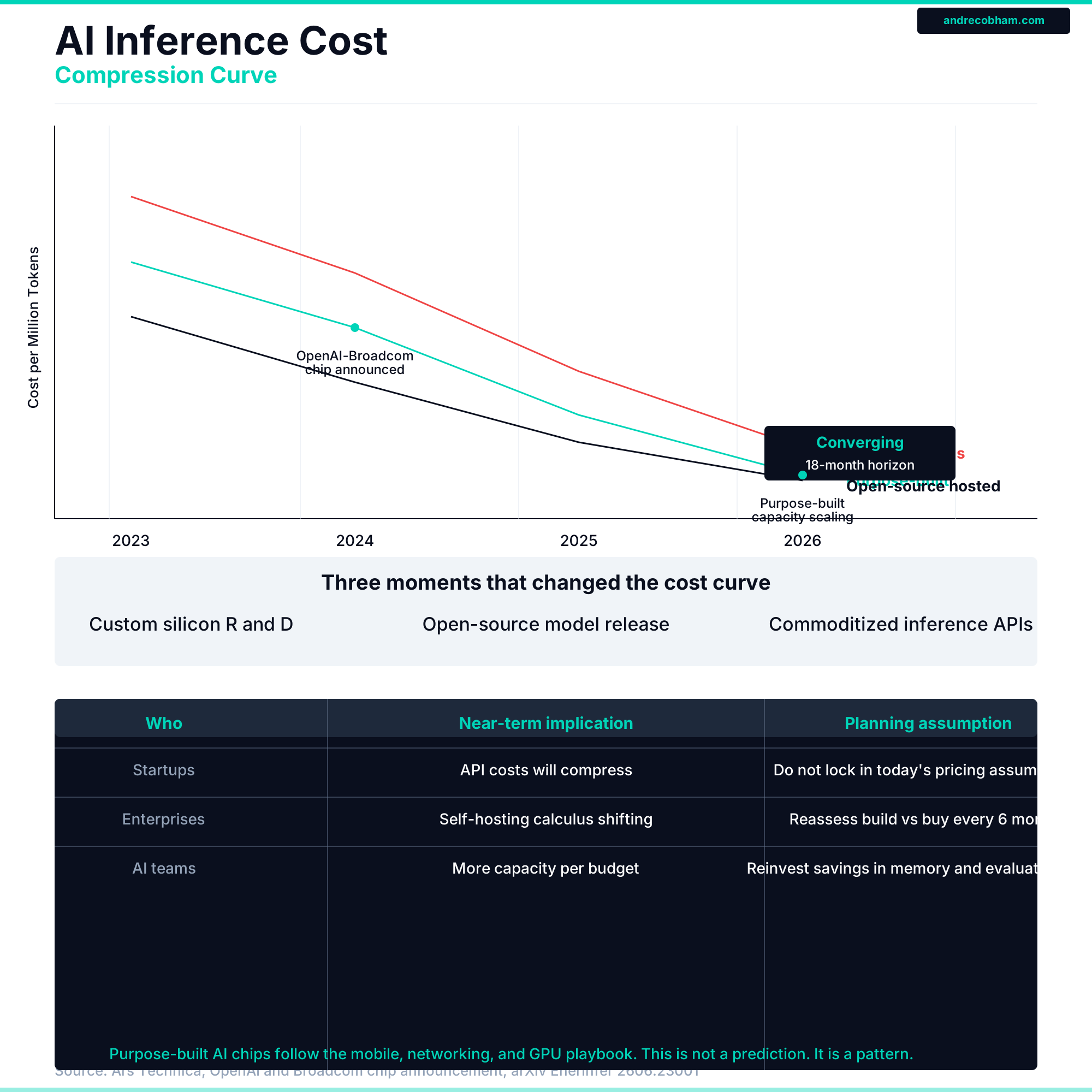
OpenAI and Broadcom announced a custom chip designed specifically for LLM inference at scale. The press coverage centered on competition with Nvidia. That framing misses the structural signal. The real signal is that inference cost is now a strategic constraint severe enough that two companies at the top of the AI stack are committing the resources required for custom silicon development. Purpose-built chips outperform general-purpose GPUs on their specific workload. This pattern has played out in mobile, networking, and storage. It is now playing out in AI inference. Source: Ars Technica.
The economics of custom silicon development follow a consistent pattern. The organizations that fund early custom chip development absorb the R&D cost and gain the performance advantage. As the chip design matures and production scales, the per-unit cost falls and the performance advantage becomes available to a broader market through partnerships, licensing, and pricing pressure on competing solutions. The current generation of AI operators is in the early phase of this cycle, which means the benefit of the OpenAI and Broadcom investment will compound over a multi-year horizon.
The near-term implication for operators is not that custom chips are available to purchase. It is that inference prices will compress as purpose-built capacity comes online at scale. OpenAI building custom inference silicon means they are investing in bringing their own inference costs down significantly. That cost reduction will eventually flow through to API pricing. Organizations making infrastructure commitments based on current per-token pricing should build in assumptions that those numbers will move down over the next 18 to 24 months.
The longer-term implication is that inference infrastructure is becoming a strategic moat for the organizations that own it. OpenAI building custom silicon is not primarily a cost-reduction play. It is a capability play: owning the inference layer gives them control over performance, latency, availability, and pricing that API-dependent organizations cannot match. The organizations that own inference infrastructure will set the terms for the organizations that depend on it.
Andre Cobham on this: Custom silicon follows the same playbook as mobile chips and networking ASICs. The early adopters fund the R&D. The rest of the market benefits from the price compression that follows at scale. Build cost models for AI workflows that assume inference pricing will continue to fall. Organizations locking in multi-year contracts at today's per-token rates without downward pricing assumptions are making a planning error.
AI: Anthropic Opens Seoul Office With Korean Enterprise Partnerships
Anthropic opened a permanent office in Seoul and announced partnerships with Korean enterprises to bring Claude into regional workflows. The geographic expansion is straightforward. What is more significant is the structure of the partnerships: integrations with Korean organizations rather than a sales office selling a standard product into a new market. Source: Anthropic.
The distinction matters because enterprise AI deployment in non-English markets is not a translation problem. It is a localization problem. A model that performs well on US enterprise workflows in English does not automatically transfer to Korean-language workflows with Korean regulatory requirements, Korean business logic, and Korean enterprise software ecosystems. The compliance requirements alone, covering data residency, financial regulations, and sector-specific AI governance frameworks that vary significantly across jurisdictions, require localization that goes deeper than language.
Anthropic's approach of building local enterprise partnerships before and alongside the office opening reflects a realistic understanding of what AI adoption at the enterprise level requires in non-English markets. It is also a competitive decision: the alternative is to let domestic Korean AI providers and well-localized models from other regions fill that market while Claude remains a niche tool for English-language workflows. The partnership-first structure is a signal that the Seoul office is designed to win enterprise adoption, not just establish a geographic presence.
For organizations deploying AI across multiple markets, the Seoul partnership structure is worth studying as a model. The organizations that build local AI capabilities through partnerships with domain-specific providers in each market will outperform those that deploy a single global model configuration and expect it to handle regional variation adequately. Market-specific compliance requirements, language nuance, and integration with local enterprise software stacks are not edge cases. They are the deployment reality for any global AI rollout.
Andre Cobham on this: Enterprise AI in international markets is a localization problem, not a translation problem. The compliance requirements, the business logic, the enterprise software ecosystems, and the cultural communication norms are all different. Organizations deploying AI across markets need to think about localization the way they think about legal entity structure: as a genuine investment, not a feature flag.
Science: EnerInfer and Energy-Aware On-Device AI Inference
According to arXiv 2606.23001, EnerInfer is a framework for energy-aware on-device LLM inference that addresses a gap in how current on-device AI systems are designed. Existing on-device AI optimizes for decoding speed, treating energy consumption as a secondary concern. The result is that sustained AI inference on mobile hardware drains batteries faster than the use cases it enables and generates heat that throttles performance during extended sessions.
EnerInfer proposes dynamic management of both compute and energy profiles during inference, scaling compute resources based on available energy budget rather than maximizing throughput at all times. The core insight is that thermal and battery constraints on mobile hardware are practical caps on effective inference performance. A system optimized for peak throughput that cannot sustain that throughput for more than a few minutes is not actually operating at peak throughput for real workloads. The paper demonstrates this with sustained-load experiments that measure effective throughput over session durations representative of real use cases.
The paper's evaluation demonstrates that energy-aware inference scheduling, where the system dynamically adjusts compute intensity based on thermal state and battery level, extends effective inference sessions significantly without proportional loss in task performance. For use cases involving sustained inference over a session, the energy-aware approach outperforms the speed-first approach in wall-clock task completion time because it avoids the thermal throttling that limits the speed-first system. The trade-off is that peak throughput is lower at the start of a session.
The practical takeaway for on-device AI deployment is that speed benchmarks measured at peak thermal state are misleading for sustained workloads. The correct evaluation metric for mobile AI is sustained throughput under real-world thermal and battery conditions, not peak tokens per second measured in a controlled environment. Any organization evaluating on-device AI for use cases involving extended inference sessions should conduct sustained-load testing before committing to a deployment architecture.
Andre Cobham on this: Speed benchmarks for on-device AI are measured under conditions that do not reflect sustained use. The thermal throttling and battery constraints that limit mobile inference are not present in the test environment. EnerInfer's approach of treating energy as a first-class constraint rather than an afterthought is the correct architecture for mobile workloads where the session duration matters as much as the peak speed.
AI: The Cost of Proprietary AI Tooling as a Formal Engineering Decision
VentureBeat published a direct comparison between Claude Code at up to $200 per month and Block's Goose, an open-source agentic coding tool that operates at zero licensing cost. The comparison examines whether the quality differential justifies the price differential. Source: VentureBeat.
The value of publishing this comparison is not the conclusion, which will vary by team and workflow. The value is that it forces the tooling cost decision into the open as an engineering decision with quantifiable parameters rather than treating premium tooling as a default that teams adopt without analysis. At $200 per month per developer, a ten-person engineering team is committing $24,000 per year to a single tooling line item. That is a commitment that warrants the same evaluation rigor as a cloud infrastructure contract.
The correct evaluation framework for this comparison is neither benchmark performance nor feature lists. The correct framework is time-to-production improvement on the specific task types the team runs most frequently, measured on actual codebases with actual tickets, over a minimum two-week period. Demos and published benchmarks answer a different question than "does this tool reduce the time it takes our team to ship?" A tool that scores higher on published benchmarks but does not match the team's actual workflow patterns produces no productivity gain regardless of its benchmark ranking.
The open-source alternative in this comparison is not a theoretical option. Goose is a production-capable agentic coding tool that teams are running on real workloads. The choice between it and a premium tool is a real engineering decision with real cost implications that engineering leadership should be making deliberately rather than by default. The comparison VentureBeat published provides the starting point for that decision. The evaluation that follows needs to run on the team's own codebase and task mix.
Andre Cobham on this: Premium AI tooling should be evaluated the same way any infrastructure investment is evaluated: what is the productivity gain, what is the cost, and what is the payback period. The answer will vary by team size, workflow type, and the specific tasks where the tool adds value. What should not vary is whether the analysis happens. $24,000 per year for a ten-person team is not a rounding error. Evaluate it.
AI: Anthropic Cowork Moves the Frontier User Beyond Developers
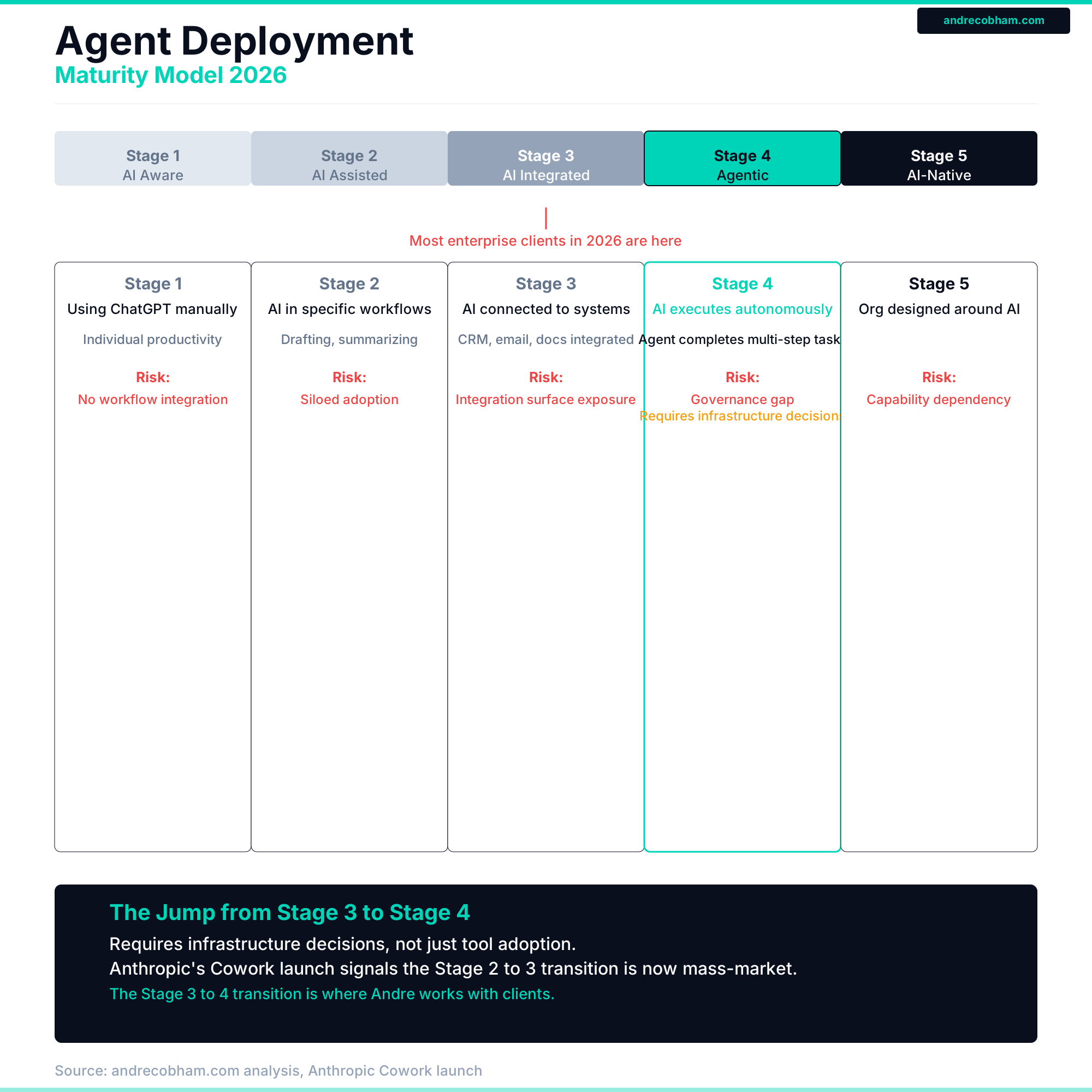
Anthropic launched Cowork, a Claude Desktop agent that can read, write, and organize across files and spreadsheets without requiring programming from the user. The launch represents a deliberate expansion of the target user beyond the developer and technical practitioner audience that has been the primary adopter of Claude Code and the API. Source: VentureBeat.
Cowork's target user is the business analyst, the operations lead, the project manager, anyone who manages documents and data professionally but does not write code. This is a substantially larger addressable market than technical practitioners. It is also the market where AI adoption has been slowest, because the path to adoption has required either learning to use developer-oriented tools or commissioning custom software to deliver AI capabilities in a non-technical interface.
For organizations deploying AI internally, Cowork's launch changes the build-versus-buy calculus for knowledge worker productivity tools. A general-purpose desktop agent that can read, write, and organize across files and spreadsheets competes directly with custom internal tools built to do the same thing. The question is whether Cowork covers enough of the organization's specific workflows to displace a point solution, or whether the workflows are specific enough to require custom development. That evaluation is now a concrete option rather than a theoretical one.
The stage transition Anthropic is signaling with Cowork is significant for how organizations should think about AI adoption strategy. The current wave of AI adoption has been driven by technical teams. The next wave requires removing the technical access requirement entirely. Cowork is a bet on what that next-wave product looks like for knowledge workers. Organizations that have been waiting for AI tools accessible to non-technical staff without custom development now have a production option to evaluate.
Andre Cobham on this: The expansion from developer tools to knowledge worker tools is the moment AI adoption becomes an organizational change management problem rather than a technology adoption problem. The hard part of deploying Cowork is not the technology. It is the workflow redesign, the governance questions about what an autonomous desktop agent is authorized to do with business documents, and the change management required to get non-technical users to adopt a new working pattern. Those are the problems organizations need to be solving now.
Sources: Ars Technica openai-broadcom-chip, anthropic.com seoul-office, arXiv 2606.23001, venturebeat.com claude-code-goose, venturebeat.com anthropic-cowork